
VAWA lets abused spouses, children and parents of U.S. citizens or permanent residents self-petition without the abuser's knowledge. Prima.Law keeps evidence and contacts organized.
Abused spouses and children of U.S. citizens or LPRs, and parents abused by a U.S. citizen son or daughter age 21 or older.
Qualifying relationship, battery or extreme cruelty, residence with the abuser, good moral character, and a good-faith marriage for spouses.
Form I-360 with evidence and no filing fee, then Form I-485 when a visa is immediately available. Spouses and children may include children under 21.
Protections under 8 U.S.C. § 1367 apply. USCIS sends interview notices to a safe address and to any legal representative on file.
The Violence Against Women Act lets certain abused spouses, children and parents of U.S. citizens, and abused spouses and children of permanent residents, file Form I-360 for themselves without the abuser's knowledge. There is no filing fee for the I-360. USCIS accepts a completed I-360 PDF upload online for VAWA self-petitioners, or it can be filed on paper.
When a visa is immediately available, the self-petitioner may file Form I-485 or proceed through consular processing. USCIS cites confidentiality protections under 8 U.S.C. § 1367 and mails interview notices to the self-petitioner's safe address and to any legal representative on file.
General information based on USCIS and other government guidance. Eligibility depends on each client’s facts; this is not legal advice.
A text to a shared phone or a call to the home number can tip off the abuser, so every staff member must follow the client's safety plan.
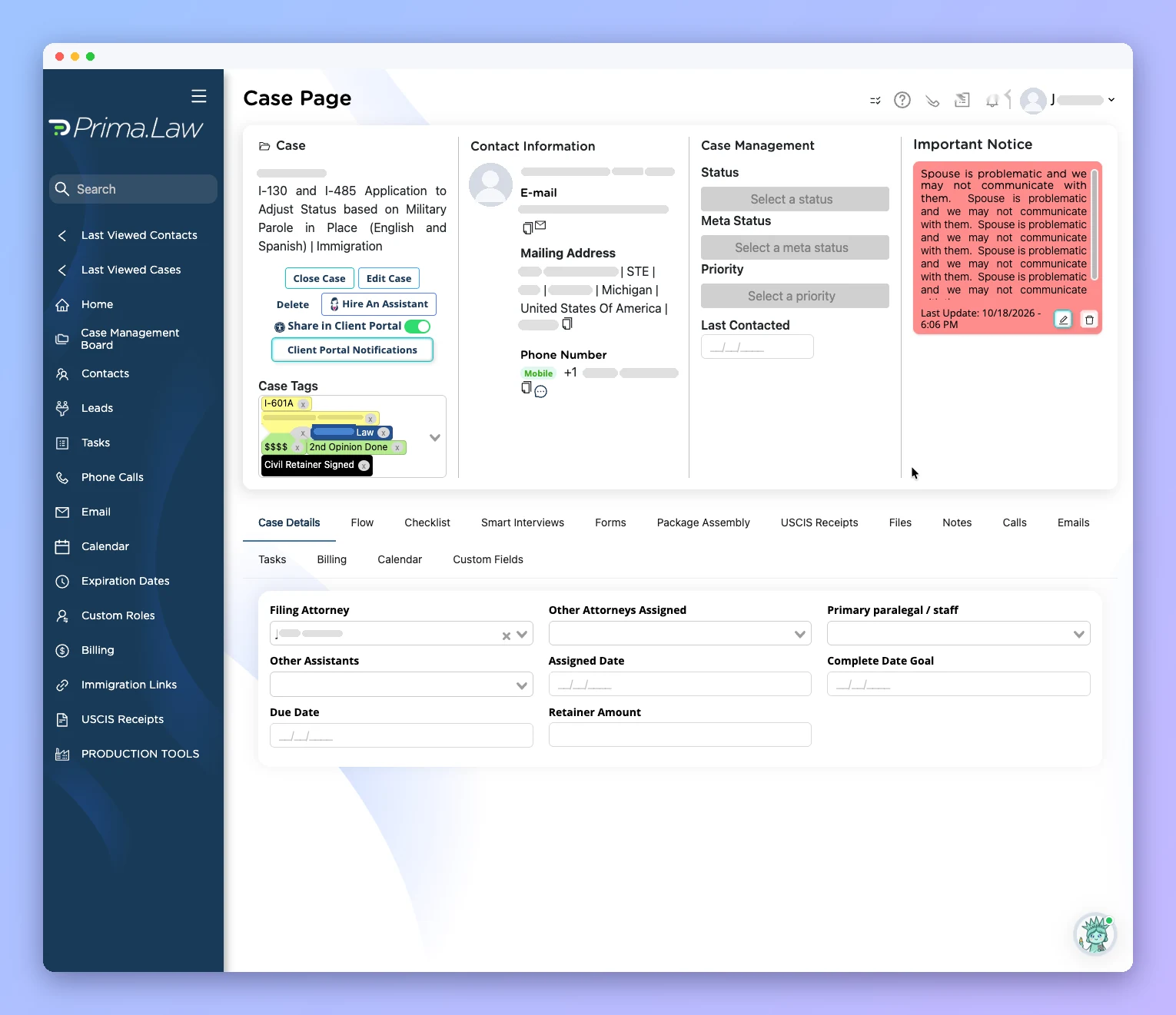
How Prima.Law helps: An Important Notice at Danger level shows safe contact rules atop the contact and every case. Texts go from the firm's Twilio number, never a personal phone, with history saved to the contact.
Protective orders, medical records, photos and affidavits arrive over months and must stay out of the abuser's reach.
How Prima.Law helps: The VAWA checklist, created and maintained by active immigration lawyers, lists relationship, abuse, residence and moral character proof. Clients upload through a portal tied to their own email.
USCIS cites confidentiality protections under 8 U.S.C. § 1367, so firms must control who sees declarations and how files are shared.
How Prima.Law helps: Gmail or Outlook email is logged to the contact and case, the firm controls which files, forms and notes the client sees, and data is AES-256 encrypted and stored in the U.S.
A VAWA case adds Form I-360, case flow items and a checklist for relationship, abuse, residence and moral character evidence, by active immigration lawyers.
Two-way texting and Gmail or Outlook email are logged to the case, so the whole team sees every message and follows the client's contact plan.
USCIS accepts a completed I-360 PDF online for VAWA self-petitioners. Autofill completes the form, and Package Assembly builds paper filings.
Add derivative children for autofill and use priority date tracking, since derivatives receive the self-petitioner's priority date.
Document the relationship, abuse, shared residence, good moral character and, for spouses, good-faith marriage.
Self-petition with USCIS. No filing fee applies, and the abuser does not take part in the process.
If prima facie eligibility is shown, USCIS issues a Notice of Prima Facie Case, usable for certain public benefits.
When a visa is available, file Form I-485 in the U.S. or proceed through consular processing via the NVC.
U nonimmigrant status for crime victims on Form I-918 and supplements
T nonimmigrant status for trafficking survivors on Form I-914 and supplements
Special Immigrant Juvenile petitions on Form I-360, from court order to green card
All humanitarian case types in Prima.Law.
Book a demo and see how Prima.Law handles VAWA Self-Petitions cases.